uses and functions of food
USES OF FOOD AND THERE FUNCTIONS
WHY WE NEED TO EAT WELL
THE FUNCTIONS OF FOOD
The Functions of Food
All foods contain one or a combination of the 6 nutrients. If you eat a balanced diet consisting of a variety of healthy foods, you are certain to receive these nutrients every day. Food has 3 main functions in the body:
Growth and Development
Babies , young children and adolescents grow at a rapid rate, while in adults and the elderly most growth has stopped and nutrients are mostly used for maintaining their bodies.
Your body cells must be able to grow and develop as you do, and food plays a major part in this. Protein, for example, is the building block for every body tissue cell such as bone, teeth, skin, and muscle. If a person is lacking protein in the diet, problems may occur such as stunted growth.
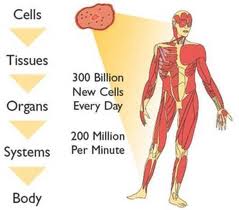
Food provides the materials needed to build, repair and maintain body tissues. Proteins, fats and minerals are the best nutrients for growth. Growing bodies need extra amounts of these nutrients. Every person, whether growing or not, is going through a continual repair process of replacing injured or dead cells. It is food that supplies the nutrients necessary for this process.
All foods contain one or a combination of the 6 nutrients. If you eat a balanced diet consisting of a variety of healthy foods, you are certain to receive these nutrients every day. Food has 3 main functions in the body:
Growth and Development
Babies , young children and adolescents grow at a rapid rate, while in adults and the elderly most growth has stopped and nutrients are mostly used for maintaining their bodies.
Your body cells must be able to grow and develop as you do, and food plays a major part in this. Protein, for example, is the building block for every body tissue cell such as bone, teeth, skin, and muscle. If a person is lacking protein in the diet, problems may occur such as stunted growth.
Food provides the materials needed to build, repair and maintain body tissues. Proteins, fats and minerals are the best nutrients for growth. Growing bodies need extra amounts of these nutrients. Every person, whether growing or not, is going through a continual repair process of replacing injured or dead cells. It is food that supplies the nutrients necessary for this process.

Energy
Food supplies the fuel or energy needed to perform the many tasks of everyday living. We need energy to think, breathe, walk, sit, speak and even sleep. We get energy from carbohydrates, proteins and fats. It is important that we eat enough food to supply all our needs. If we don't, we will feel tired and listless. Having no energy can be compared to a car that has run out of petrol. On the other hand, if we eat more energy food than our body needs, this energy will be stored in the body as fat. Too much stored energy will result in the body becoming overweight or obese.
Use the following links to conduct research and answer the questions:
Extension reading
What is Energy?
What are your energy needs?
How can we supply our bodies with healthy energy?
Food supplies the fuel or energy needed to perform the many tasks of everyday living. We need energy to think, breathe, walk, sit, speak and even sleep. We get energy from carbohydrates, proteins and fats. It is important that we eat enough food to supply all our needs. If we don't, we will feel tired and listless. Having no energy can be compared to a car that has run out of petrol. On the other hand, if we eat more energy food than our body needs, this energy will be stored in the body as fat. Too much stored energy will result in the body becoming overweight or obese.
Use the following links to conduct research and answer the questions:
Extension reading
What is Energy?
What are your energy needs?
How can we supply our bodies with healthy energy?

Repair and Maintain Cells
Achieving good health is one thing, but keeping it is another. You need to maintain your health, and you need good food in order to do this. For example, your skin is often cut or grazed, your hair falls out constantly and your red and white blood cells die on a regular basis. By consuming the right nutrients, your body will repair itself and stay healthy.
Similarly, you must be well enough to fight infection and disease. A healthy individual who eats well and exercises regularly is less likely to suffer from a cold or flu than a person who eats poorly and does not exercise.Vitamins, minerals and protein keep the body's tissues and organs healthy. Healthy organs are less likely to be attacked by disease.
NUTRITIONAL COMPONENTS
THE 6 NUTRIENTS
Everybody needs to eat food in order to survive. Different foods give us the 6 nutrients which we need to maintain good health. Without these food nutrients you would die!
CARBOHYDRATES
Carbohydrates are sugars, starches and fibre. The simplest forms of carbohydrates are sugars such as glucose, sucrose, dextrose, fructose and lactose. Starches are complex forms of carbohydrate that during the process of digestion are broken down to simple sugars. Fibre is a non-digestible form of carbohydrate found in grains, cereals, breads fruit and vegetables.
Carbohydrates are a major source of fuel and energy, and they allow protein used for growth and maintenance of body cells. The dietary fibre found in unrefined products is important for proper bowel function. The main sources of carbohydrates are breads, breakfast cereals, rice, pasta, lentils, fruit and vegetables. Smaller amounts can be found in milk and other dairy products.
Carbohydrates are called simple or complex, depending on their chemical structure.
Simple carbohydrates are absorbed quickly, they also used quickly providing energy for a shorter amount of time. Simple carbohydrate are sugars found naturally in foods such as fruits, vegetables, milk, and milk products. They also include sugars added during food processing and refining.
Complex carbohydrates are absorbed and processed slowly by the body and therefore provide energy for a longer period of time. Complex carbohydrates include whole grain breads and cereals, starchy vegetables and legumes. Many of the complex carbohydrates are good sources of fiber. Complex carbohydrates keep you feeling satisfied from hunger for longer, you are less likely to crave snack foods if you include complex carbohydrates in your meals. No
For a healthy diet, limit the amount of added sugar that you eat and choose whole grains over refined grains. Excess sugar stored in the liver converts to fat if unused as energy.
Carbohydrates are a major source of fuel and energy, and they allow protein used for growth and maintenance of body cells. The dietary fibre found in unrefined products is important for proper bowel function. The main sources of carbohydrates are breads, breakfast cereals, rice, pasta, lentils, fruit and vegetables. Smaller amounts can be found in milk and other dairy products.
Carbohydrates are called simple or complex, depending on their chemical structure.
Simple carbohydrates are absorbed quickly, they also used quickly providing energy for a shorter amount of time. Simple carbohydrate are sugars found naturally in foods such as fruits, vegetables, milk, and milk products. They also include sugars added during food processing and refining.
Complex carbohydrates are absorbed and processed slowly by the body and therefore provide energy for a longer period of time. Complex carbohydrates include whole grain breads and cereals, starchy vegetables and legumes. Many of the complex carbohydrates are good sources of fiber. Complex carbohydrates keep you feeling satisfied from hunger for longer, you are less likely to crave snack foods if you include complex carbohydrates in your meals. No
For a healthy diet, limit the amount of added sugar that you eat and choose whole grains over refined grains. Excess sugar stored in the liver converts to fat if unused as energy.

Glycemic Index (GI) is a reference as to how fast and for how long your body processes the sugar or carbohydrates as energy in your body.
High GI foods contain mostly simple carbohydrates. The sugars in simple carbohydrates are broken down easily by the body and therefore absorbed quickly into the blood supply. Energy levels then fall just as quickly causing fatigue and cravings.
Low GI Foods contain complex carbohydrates. The sugars in complex carbohydrates are harder for the body to break down and therefore are absorbed gradually into the blood supply over a greater amount of time, reducing cravings and energy spikes and crashes.
High GI foods contain mostly simple carbohydrates. The sugars in simple carbohydrates are broken down easily by the body and therefore absorbed quickly into the blood supply. Energy levels then fall just as quickly causing fatigue and cravings.
Low GI Foods contain complex carbohydrates. The sugars in complex carbohydrates are harder for the body to break down and therefore are absorbed gradually into the blood supply over a greater amount of time, reducing cravings and energy spikes and crashes.

PROTEIN
Proteins are essential for growth and maintenance of a healthy body. They are the body's main building material. They are used to make new cells for muscle tissue, skin, hair, blood and so on. Their main functions are building, repairing and replacing cells.
Proteins are found in meat, poultry, fish, eggs, dairy products, lentils, nuts, breads and cereals.
Protein is in every living cell in the body. Our bodies need protein from the foods we eat to build and maintain bones, muscles, organs, teeth and skin.
There are 2 types of Protein Complete and Incomplete
Proteins from meat and other animal products are complete proteins. This means they supply all of the 8 amino acids the body can't make on its own.
Examples of complete proteins are: meat, fish , eggs, milk, cheese and yoghurt.
Plant proteins are incomplete. This means they lack at least 1 of the essential 8 amino acids. You must combine them to get all of the 8 amino acids your body needs.
Examples of incomplete proteins are: nuts, pulses, seeds, wholegrain cereals and vegetables
It is important to get enough dietary protein. You need to eat protein every day, because your body doesn't store it the way it stores fats or carbohydrates.
Proteins are found in meat, poultry, fish, eggs, dairy products, lentils, nuts, breads and cereals.
Protein is in every living cell in the body. Our bodies need protein from the foods we eat to build and maintain bones, muscles, organs, teeth and skin.
There are 2 types of Protein Complete and Incomplete
Proteins from meat and other animal products are complete proteins. This means they supply all of the 8 amino acids the body can't make on its own.
Examples of complete proteins are: meat, fish , eggs, milk, cheese and yoghurt.
Plant proteins are incomplete. This means they lack at least 1 of the essential 8 amino acids. You must combine them to get all of the 8 amino acids your body needs.
Examples of incomplete proteins are: nuts, pulses, seeds, wholegrain cereals and vegetables
It is important to get enough dietary protein. You need to eat protein every day, because your body doesn't store it the way it stores fats or carbohydrates.

VITAMINS
Vitamins are essential for the normal functioning of our bodies (metabolism), growth and development. They are needed in only very small amounts for normal growth and health. Each vitamin (named alphabetically) is made up differently and all have very specific jobs to do in the body. Vitamins act as regulators. They are essential for the release of energy within the body, for building tissue and for controlling how the body uses food.
Sources of vitamins are mainly fruit and vegetables, but specific vitamins can be found in other foods, such as milk, eggs, cereals, nuts, yeast, liver, fish and meat.
Sources of vitamins are mainly fruit and vegetables, but specific vitamins can be found in other foods, such as milk, eggs, cereals, nuts, yeast, liver, fish and meat.

MINERALS
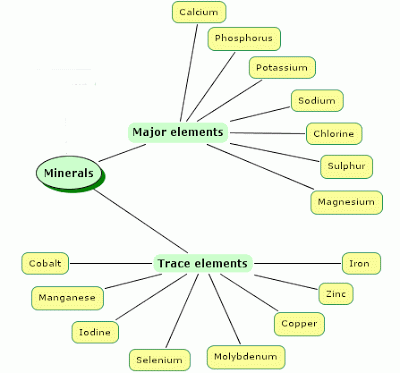
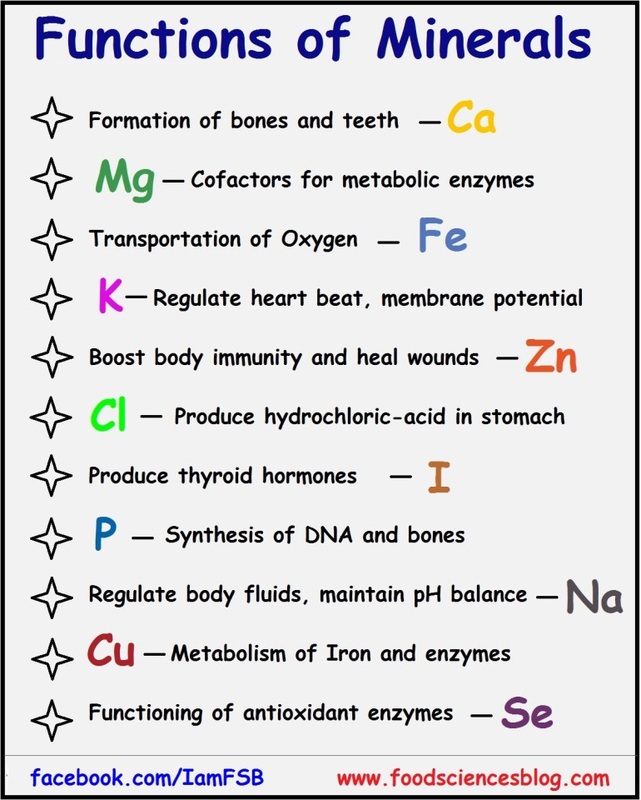
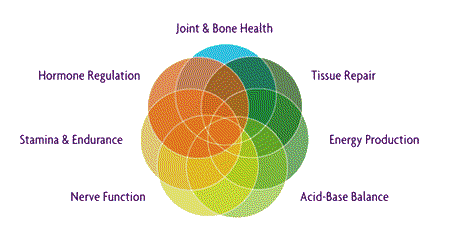
Minerals are inorganic substances (i.e. they don not contain carbon) required by the body for many metabolic processes. They form part of the structure of hormones, enzymes and vitamins. They are necessary for the correct functioning of the body. Like vitamins, they are needed in only very small amounts and do not provide energy. They help regulate water balance, muscle contraction and nerve function.
Minerals are found in all foods, so that eating a varied and balanced diet should provide the necessary amounts for good health.
Extension Reading: Food Science Blog
Minerals are found in all foods, so that eating a varied and balanced diet should provide the necessary amounts for good health.
Extension Reading: Food Science Blog
FATS AND LIPIDS
The technical word for fats is lipids. They are the most concentrated source of energy found in the diet and are found in both animal and plant foods. Besides being a major source of energy, fats supply and help the absorption of fatty acids and fat soluble vitamins (A, D, E and K) which do not dissolve in water but do dissolve in lipids. Lipids are also used in the structure of all cells and nervous tissue.
Sources of fats are butter, margarine, vegetable oils, dripping, dairy products, fatty meats, chicken, egg yolks, nuts and seeds. Only very small amounts of fat are needed.
Extension Reading: Healthy Fats
Sources of fats are butter, margarine, vegetable oils, dripping, dairy products, fatty meats, chicken, egg yolks, nuts and seeds. Only very small amounts of fat are needed.
Extension Reading: Healthy Fats

WATER
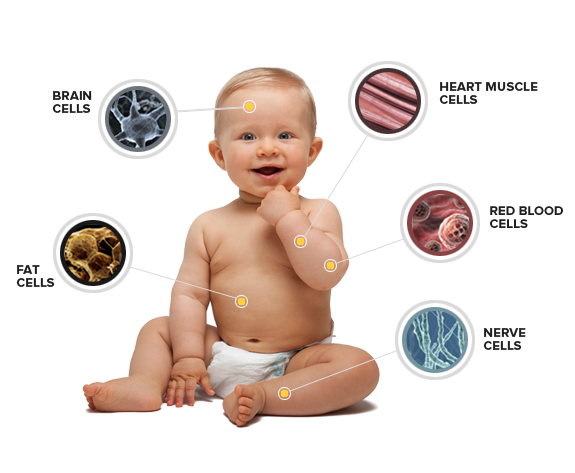
Over two-thirds of our body weight is made up of water. It is needed for the functioning of every cell and organ in the body, for lubrication, temperature control and excretion. Approximately 1.5 to 2.5 litres of water is needed each day for good health. Water is found in all foods but we need to drink extra fluids to replace water lost by urine, moist exhaled air and perspiration.
Comments
Post a Comment